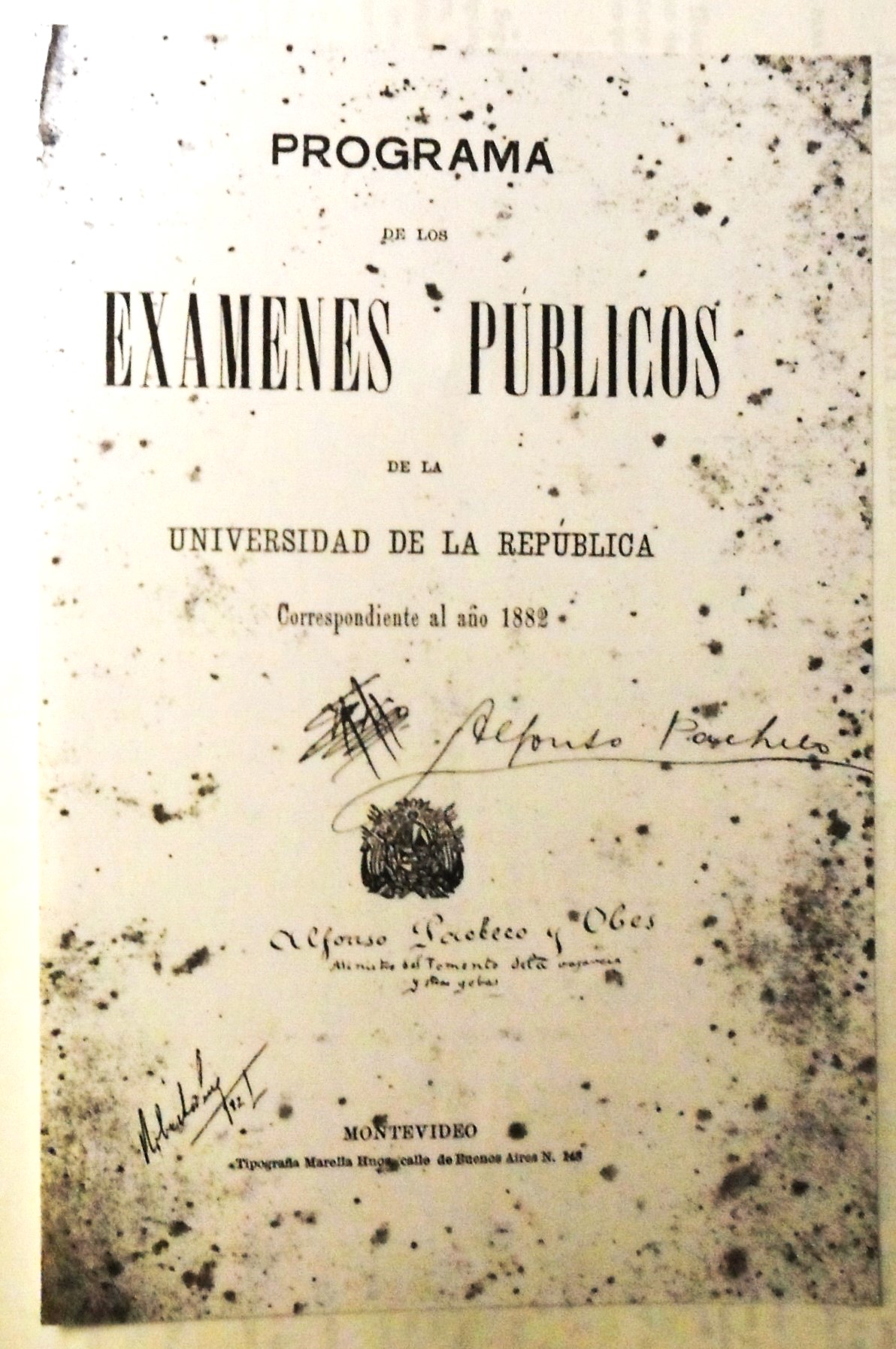
Elías Regules at the University of the Republic’s School of Law. The program and unpublished notes from the forensic medicine classroom
DOI:
https://doi.org/10.35954/SM2026.45.1.10.e701Keywords:
Lawyers, biographies, schools, medical, medicine history, medical interpreting, jurisprudence, forensic medicine, coroners and medical examiners, enacted statutes, UruguayAbstract
Introduction: This article highlights the figure of Elías Regules (1861–1929) not only as a leading figure in Uruguayan traditionalism but also as a cornerstone of forensic medicine education at the University of the Republic’s School of Law. This study is warranted by the scarcity of historical records on this subject, which was considered marginal at the time, and by the discovery of unpublished notes that allow us to reconstruct Regules’ pedagogical thought between 1885 and 1924. The main objective is to document the history of the forensic medicine classroom, the influence of the 1889 criminal code on teaching, and the analysis of his methodology through primary sources.
Materials and methods: The research is historiographical and documentary in nature. Primary sources were analyzed, institutional archives were reviewed, and the 1882 curriculum by Antonio Martín Galindo and the 1891 curriculum by Regules were compared with the 1889 Penal Code. A bibliographic study and an analysis of university regulations from the late 19th century were also conducted.
Results: Antonio Martín Galindo was identified as the first professor of the department in 1882, and he designed the first curriculum based on Spanish texts. Following Regules’ arrival in 1885, the curriculum expanded from 9 to 19 chapters by 1891. This change was a direct response to the enactment of the Penal Code of 1889, incorporating topics such as criminal responsibility (insanity, intoxication), crimes against persons (infanticide, abortion, homicide), and forensic techniques (toxicology, autopsies). A single copy of his lecture notes was located, showing that Regules not only taught medicine but also adapted medical knowledge to the medico-legal method, focusing on its utility for lawyers and judges.
The notes reveal a pragmatic and critical perspective for his time; for example, on the topic of abortion.
Discussion: Regules’ work demonstrates that forensic medicine served as an essential bridge for the professionalization of criminal law in Uruguay. It is noteworthy that Regules’ approach was superior in technical specificity to many contemporary curricula.
Conclusions: Even with his fame as a man of letters and politician, his 43-year career as a teacher was technical, engaging, and enlightened. The discovery of the notes fills a critical bibliographic gap, confirming that Regules trained both the experts who would work within the judicial system and the lawyers who would interpret their rulings in the new light of modern codification.
NOTE: This article has been approved by the Editorial Committee.
Received for review: December 2025.
Accepted for publication: March 2026.
Publication date: April 2026.
Correspondence: 21 de Septiembre 2713, Apt. 401, C.P. 11300, Tel.: (+598) 27101418, Montevideo, Uruguay.
Contact email: asoiza@adinet.com.uy
Downloads
References
El gran cantor del terruño. Elías Regules. El Terruño. Revista Campera 1917; 1(2):1. Disponible en: https://anaforas.fic.edu.uy/jspui/handle/123456789/48854 [Consulta 02/02/2025].
Soiza Larrosa A. Medicina y Derecho bajo la dominación española. Un capítulo poco conocido de la historia colonial 1724-1813. Revista del Instituto Histórico y Geográfico Uruguay 2008; XXX:93-118.
Paris de Oddon, B. La Universidad de Montevideo en la formación de nuestra conciencia liberal 1849-1885. Montevideo: Universidad de la República, 1958, p.54-55.
Ardao MJ. Alfredo Vásquez Acevedo. Contribución al estudio de su vida y su obra. Rev. Hist., 1969; 2ª época, tomo XL:118-120.
Soiza Larrosa A. Prof. Dr. Abel Zamora (1863-1964). [en línea]. 2011. 20 p. Disponible en: https://www.smu.org.uy/dpmc/hmed/historia/articulos/zamora-b.pdf [Consultado 02/02/2025].
Soiza Larrosa A. Los Programas de Medicina Legal en las Facultades de Medicina y Abogacía (1882-1945). Ses. Soc. Urug. Hist. Med. 1998; XIX:13-20.
Paris de Oddone B. La Universidad de Montevideo en la formación de nuestra conciencia liberal 1849-1885. Montevideo: Universidad de la República, 1958, p. 11.
Carámbula Regules de Barreiro M. Elías Regules 1861-1929. En: Horacio Gutiérrez Blanco (ed.). Médicos Uruguayos Ejemplares. Buenos Aires: Prensa Médico Argentina, 1988. Tomo I, p. 7-13.
Aller G. Síntesis histórica de la Cátedra y del Instituto de Derecho Penal en la Facultad de Derecho. Nexo 2009; 15(129):15-29.
Aller G. Evolución de la ley penal en el Uruguay. Rev. Fac. Der. 2010; 29:45-53. Disponible en: https://www.redalyc.org/pdf/5681/568160365004.pdf [Consulta 03/02/2025].
Uruguay. Código Penal de la República Oriental del Uruguay. Montevideo: Imprenta El Siglo Ilustrado, 1889. 128 p.
Uruguay. Universidad de la República. Facultad de Derecho. Aula de Medicina Legal. Programa. Anales de la Universidad 1891; I(I):83-86.
Bernard C, Mazzella H, Mañé Garzón. Montevideo: Fundación Beisso-Fleurquin: Academia Nacional de Medicina, 1989. Apuntes tomados por Teodoro M. Vilardebó del primer curso sobre Phisiologie expérimentale dictado por Claude Bernard en el collége de Fance: (1847-1848). Seguido de Vilardebó: (1803-1857): primer médico uruguayo. Montevideo: Fundación Beisso-Fleurquin, 1989. 535 p.
Barbato D. Clínica de Niños. Apuntes de clase del Prof. Morquio. Prólogo del Prof. Dr. José Bonaba. Montevideo: Claudio García y Cia. Editores, 1936.
Mata P. Tratado de medicina y cirugía legal teórica y práctica, seguido de un compendio de toxicología. Madrid: Bailly-Bailliere, 1866-1867.
Regules E. Disposiciones nacionales con interés médico-legal: coleccionadas para los estudiantes de medicina. 1a. ed. Montevideo: Imprenta Rural, 1892. 60 p.
Uruguay. Universidad de la Republica. Facultad de Derecho. Archivo Histórico Administrativo, UDC 027/1929, EI-A7-C24. Asociación Uruguaya de Estudiantes de Notariado. Directiva. Disponible en: https://www.fder.edu.uy/html/uploads/r/facultad-de-derecho-4/2/2/2223/1929-027_01.jpg [Consulta 01/02/2025].
Downloads
Published
How to Cite
Issue
Section
License
Copyright (c) 2026 : Augusto Soiza Larrosa.

This work is licensed under a Creative Commons Attribution-NonCommercial-ShareAlike 4.0 International License.
Until 2024 we use the Creative Commons Attribution/NonCommercial Attribution 4.0 International License https://creativecommons.org/licenses/by-nc/4.0/deed.es. Which states that: you are free to share, copy and redistribute the material in any medium or format, as well as to adapt, remix, transform and build upon the material. Under the following terms:
Attribution: you must give proper credit , provide a link to the license, and indicate if changes have been made . You may do so in any reasonable manner, but not in such a way as to suggest that you or your use is endorsed by the licensor.
NonCommercial: you may not use the material for commercial purposes.
As of 2025 authors retain their copyright and assign to the journal the right of first publication of their work, which shall simultaneously be subject to the license https://creativecommons.org/licenses/by-nc-sa/4.0/deed.es that permits sharing, copying and redistribution of the material in any medium or format provided that initial publication in this journal is indicated. Adapt, remix, transform and build upon the material. If you remix, transform, or build from the material, you must distribute your contribution under the same license as the original and may not make use of the material for commercial purposes.
Under the following terms:
1. Attribution: you must give proper credit, provide a link to the license, and indicate whether changes have been made. You may do so in any reasonable manner, but not in such a way as to suggest that you or your use is endorsed by the licensor.
2. NonCommercial: you may not use the material for commercial purposes.
3. ShareAlike: if you remix, transform or build upon the material, you must distribute your contribution under the same license as the original.




PlumX Metrics